The Testament of Ann Lee (2025)
I’m not religious but I love to dance. I don’t want to pretend like they’re the same thing but I do sometimes feel like I ascend to some kind of blissful heavenly plane amidst a sweaty crowd with a pulsing rhythm ringing in my ears. For this reason my entry point into The Testament of Ann Lee was much more through the physical world rather than the spiritual one.
Mona Fastvold’s film tells the “true legend” of Ann Lee (played magnificently by Amanda Seyfried), founder of the Shaker religious movement: a sect of Christianity in the 18th century that are most known for their shaking way of worship and belief in complete celibacy, even after marriage. The film also emphasizes their utopian ideals of equality and dedication to hard work and craft.
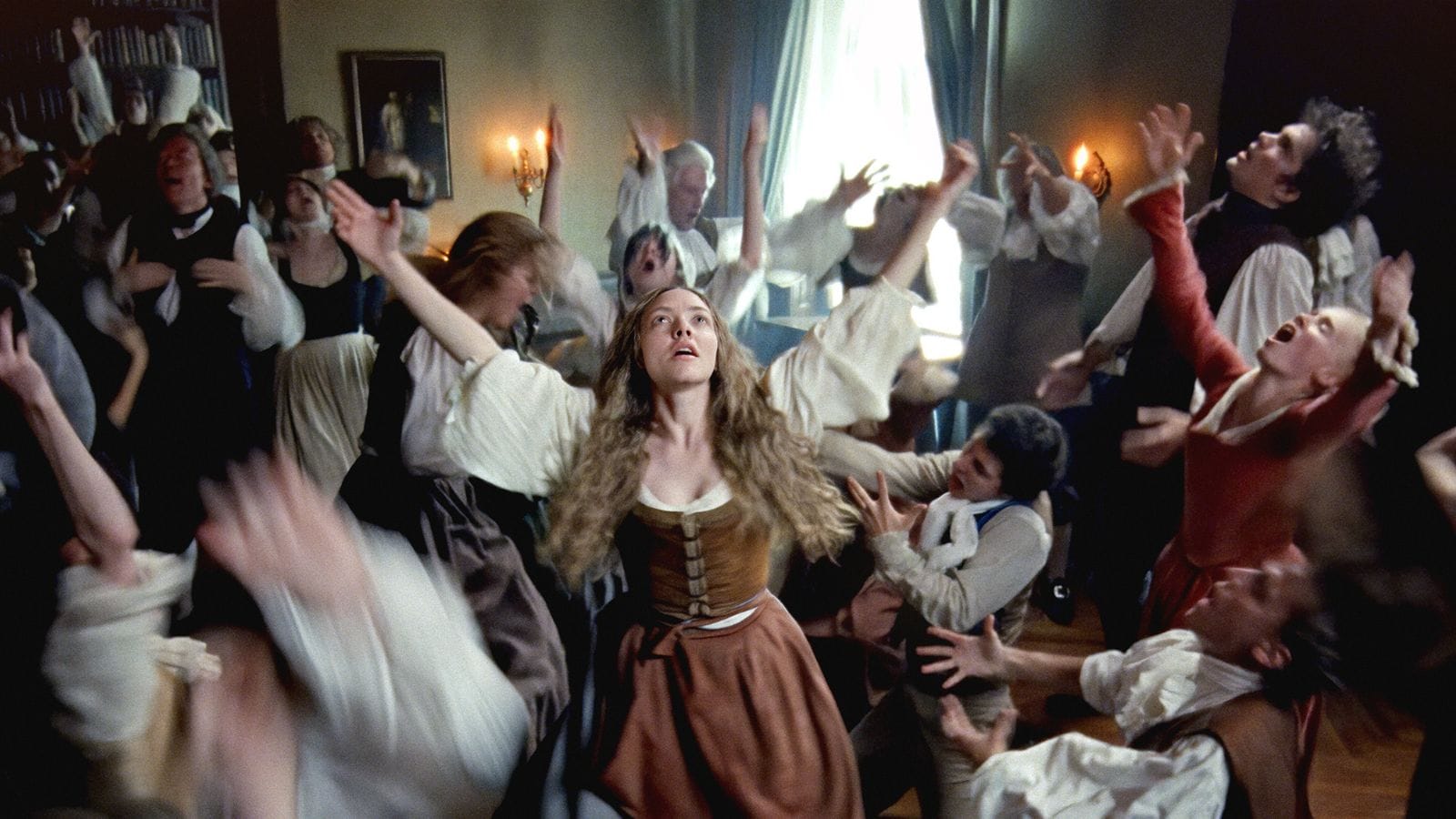
I find the literal plot points of the story a little uninteresting. It sometimes feels a little like a standard biography of a religious figure: their unassuming childhood, spiritual revelation, growth in power and finally their defiance against rival philosophies and political forces. It’s much more interesting in the way it depicts the divine as a tangible, full-body experience. Taking inspiration from the rapid breathing, shrieking and chest hitting common during Shaker services, the musical numbers dip into something beautiful, strange and surreal.
It's giving getting down at Bilbo's 111th birthday
I often compliment art as being tactile or visceral – words I keep reaching for to describe The Testament of Ann Lee, even when they fall short of what I want to convey. I suppose I’m trying to gesture towards how the film feels immediate in my body while watching, achieving a humming resonance in my brain despite its otherworldly elements, evoking some feeling that made me think (shallowly, stupidly) I get religion now.
Or more accurately I came to see the world in the way that Ann Lee seems to as she works towards equity and community, a value of what can be built together through shared dedication. There’s a sequence of the film that simply shows the furniture and goods made by Shaker craftspeople: delicately curved wooden boxes, a chair hanging from a hook, a porcelain bowl atop a hardwood cabinet, a twisting iron apple corer. Hand to god I shed a tear at their beauty.
I couldn’t help but think of the parallels with filmmaking itself, an artistic undertaking that is both an art and a craft. A marriage between the lofty ideological goals of imparting ideas through story and the precise physical labor it takes to make that happen. The sewing and dyeing of cloth for costumes, a choreographer’s vision come to life through the bodies of others, the building of a wooden church just to film it being burnt to the ground.
So maybe it doesn’t matter that some of the more god-heavy parts of The Testament of Ann Lee left me a little cold. Because by the end I reached some kind of equilibrium with the film: that feeling I get on the dance floor sometimes of some kind of transcendent peace, both totally alone and totally connected to others all at once.
Each month I highlight an organization that’s important to me. I encourage people to check out the cool work they do, and also to find causes within their community to support as well.
Today I’m linking to a list of fundraisers for the families affected by the five-alarm fire in my neighborhood last week.